
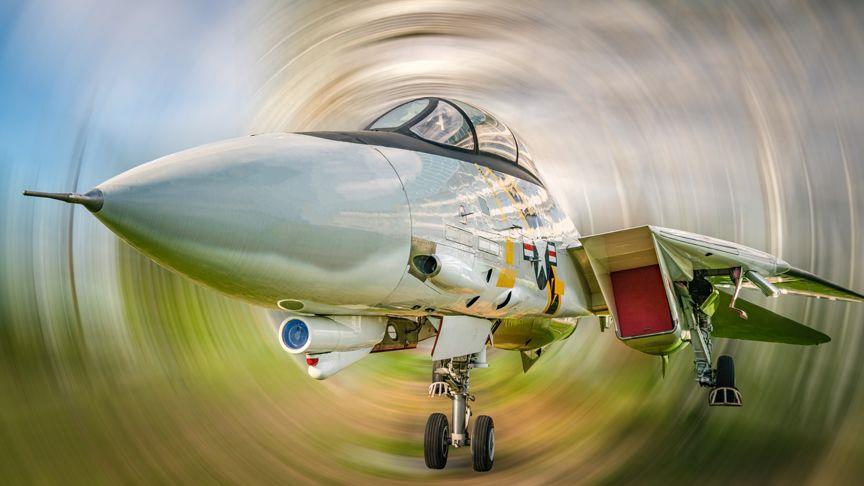
It’s amazing how history bends and turns. In recent days, with tension between the United States and Iran heating up again, this time in Syria, I thought of the fighter jet which has been a mainstay to the Iranian Air Force—the F-14, built here on Long Island, in Nassau and, yes, Suffolk County.
My mind went back to 50 years ago when there was a press event at the Grumman facility in Calverton, a manufacturing and the final assembly plant for Bethpage-based Grumman as well as its site for tests flights.
Reporters were invited to be there as U.S. Representative Otis G. Pike of Riverhead was to take a ride on what was a prize new product of Grumman, its two-seater F-14 “Tomcat” fighter jet. (It’s the plane featured in Tom Cruise’s 1986 movie “Top Gun.”) Pike, outfitted in a flight suit, who represented the lst Congressional District from 1961 to 1979, was no stranger to warplanes. During World War II he served as a Marine Corps dive bomber and fighter pilot through the war in the Pacific.
Walking into the huge Grumman plant, I wasn’t surprised to see a bunch of F-14s with U.S. Navy markings. Grumman for the decades following its founding in 1929 as Grumman Aircraft Engineering Corporation by Leroy Grumman and partners, it became a prime manufacturer of airplanes for the Navy.
But I was surprised to see a bunch of F-14s with strange markings.
They were being produced for Iran. Indeed, Iran was the only foreign nation to which the F-14, considered a highly advanced fighter in its time, was ever sold.
In fact, the sale of those jets to Iran was considered pivotal to Grumman. It was “the contract that really saved it,” relates David Hugh Onkst in an exhaustive 640-page Ph.D. dissertation on Grumman history presented in 2011 at American University. (It is online.) “In 1974, the Shah of Iran signed a $2 billion contract for eighty F-14s.” It “would be” the “contract that rescued the company” at that point deep in debt, he related.
But then came the Iranian revolution in 1979 and the ouster of Shah Mohammad Reza Pahlavi, and the Iranian hostage crisis after the U.S. Embassy in Tehran was seized that year with 50 Americans held hostage for 444 days. Relations between the U.S. and Iran have never, to say the least, been the same. From allies, the countries became enemies.
 |
| File Photo |
The article provided background for the interest of the shah in the F-14. He “wanted weapons. And not just any weapons. Himself a former military pilot, the king wanted the latest and best U.S.-made warplanes, with which the Iranian Air Force might dominate the Persian Gulf and even patrol as far away as the Indian Ocean….The administration of U.S. President Richard Nixon was all too eager to grant the shah’s wish in exchange for Iran’s help balancing a rising Soviet Union…That’s how, starting in the mid-1970s, Iran became the only country besides the United States to operate arguably the most powerful interceptor jet ever built—the Grumman F-14 Tomcat.”
The piece continued: “It’s fair to say American policymakers quickly regretted giving Iran the F-14s….The Islamic revolution transformed Iran from an American ally to one of the United States’ most vociferous enemies….For the next five decades, the United States would do everything in its power—short of war—to ground the ayatollah’s Tomcats. But the Americans failed. Through a combination of engineering ingenuity and audacious espionage, Iran kept its F-14s in working order—and even improved them. The swing-wing fighters took to the air in several conflicts and even occasionally confronted American planes. Today Iran’s 40 or so surviving F-14s remain some of the best fighters in the Middle East.”
Despite efforts to prevent replacement parts for the F-14 from getting to Iran, they’ve gotten there. “The parts war escalated after the U.S. Navy retired its last F-14s in 2006…In 2007, U.S agents even seized four intact ex-U.S. Navy F-14s in California—three at museums….Even so, the underground trade in Tomcat parts continues, with shady companies scouring the planet for leftover components.”
“Five decades in, Iran’s F-14s are only getting better and better,” the article concluded.
Back on Long Island, an F-14 has just been fully restored to be displayed at the Cradle of Aviation Museum in Garden City. (The restoration costs were covered by Northrop Grumman. In 1994 Grumman merged with Virginia-headquartered Northrop.) “We are the keeper of the legacy of Grumman,” the museum’s president, Andy Parton, has said. It is the 711th of the 712 F-14s built by Grumman on Long Island.
Yes, Long Island’s F-14 still hangs on in these parts—and in Iran.